Reading 22 Indian scripts with a small model
How a 0.9B vision-language model went from 36 to 76 on Sarvam's Indic OCR bench, what real printed pages taught it, and why long pages still end too soon.
Updated
Measured on the public Sarvam Indic OCR bench with Sarvam's own scoring script (November 2026). v6 is a research model, not yet a product; Sarvam Vision 2.1 still leads by 10.8 points.
Live read · a held-out page the model never trained on
01 Original print
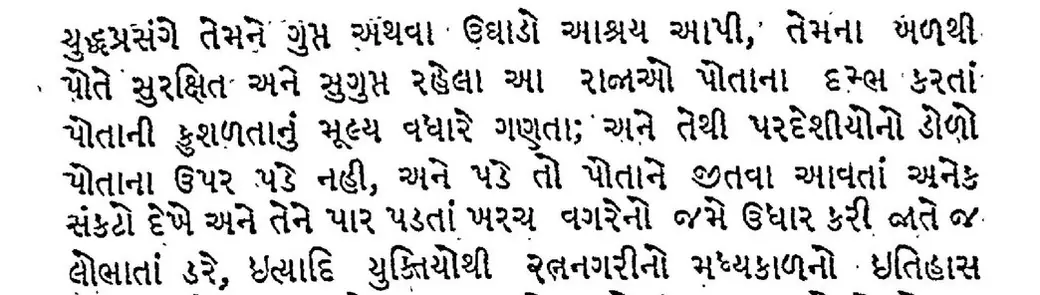
02 Saved model reading
યુદ્ધપ્રસંગે તેમને ગુપ્ત અથવા ઉઘાડો આશ્રય આપી, તેમના બળથી
પોતે સુરક્ષિત અને સુગુપ્ત રહેલા આ રાજાઓ પોતાના દમ્ભ કરતાં
પોતાની કુશળતાનું મૂલ્ય વધારે ગણતા; અને તેથી પરદેશીયોનો ડોળો
પોતાના ઉપર પડે નહી, અને પડે તો પોતાને જીતવા આવતાં અનેક
સંકટો દેખે અને તેને પાર પડતાં ખરચ વગરેનો જમે ઉધાર કરી જાતે જ
લોભાતાં ડરે, ઇત્યાદિ યુક્તિયોથી રત્નનગરીનો મધ્યકાળનો ઇતિહાસ
In this paper 12 sections
Reading print in the languages people actually use
Most of India's printed record is not in English: textbooks, court orders, newspapers, out-of-copyright books and government forms in twenty-two scheduled languages and a dozen scripts. A model that reads them well is the first step to searching, quoting and answering from those pages. A model that reads them badly is worse than none, because a confident wrong transcription looks exactly like a right one.
We set out to see how far a small open model could go. Not a frontier system with tens of billions of parameters, but PaddleOCR-VL, a vision-language model of about 0.9 billion parameters that fits beside other work on one graphics card. The question was concrete: on real printed pages, scored by someone else's rules, how close can it get to the best Indian OCR model available?
This report follows every version we trained, including the ones that did not do what we predicted. Each number on this page comes from the saved benchmark results; none is typed by hand.
Someone else's test, someone else's scoring
We measure on Sarvam AI's public Indic OCR benchmark: 6,908 images of printed text blocks from newspapers, textbooks and historical print in twenty-two Indian languages and English. We score with Sarvam's own metrics script and its normalisation. Word accuracy is one hundred times one minus the mean word error rate, so a page that stops halfway loses every word it never wrote.
The benchmark is used for testing only. No benchmark image or sentence is ever used for training, and our training text is filtered against benchmark lines so that a sentence sharing a long run of characters with any test line is dropped. Every version below was scored with identical settings on the same images.
Sarvam reports 87.4 for Sarvam Vision 2.1 on this benchmark. That number is theirs, not a run of ours; we quote it as the reference point, not as a head-to-head measurement under identical conditions.
Where the base model starts
The untouched base model scores 36.0. It reads English, Bengali, Tamil and Hindi reasonably well and almost nothing else: Kannada 8.4, Malayalam 7.7, Odia 1.9, Manipuri 0.0. Those scripts were simply not part of what it learned to read.
That makes it a useful starting point rather than a weak one. The visual machinery that finds lines and characters is already there. What it lacks is exposure to the shapes of most Indian scripts and to the way those scripts look when printed on old paper and scanned.
Six versions in a week
v1 was trained on synthetic single lines: sentences rendered in open fonts for every script. It jumped to 66.3. v2 added multi-line blocks with simulated print damage (halftone, bleed-through, low resolution) and reached 70.0. v3 added three scripts the earlier data had no text for, Meitei Mayek for Manipuri, Ol Chiki for Santali and the Kashmiri alphabet, and reached 72.8.
v4 was the first to read real print: proofread public-domain books from Wikisource, aligned line by line to their scans. It reached 75.8. v5 added more real print for Bengali, Kannada, Tamil and Malayalam and scored 76.3, a smaller gain than we predicted. v6 kept v5's data and added long real and synthetic blocks of sixteen to forty lines; it scored 76.6, again less than we predicted, for reasons the next sections explain.
Every version continued from the previous one rather than starting again, and each was scored on the full benchmark before the next was trained.
%
Basestart
- 36.0
v110/30
- 66.3
v210/31
- 70.0
v310/31
- 72.8
v411/01
- 75.8
v511/04
- 76.3
v611/05
- 76.6
Sarvamreported
- 87.4
From 36.0 for the untouched base model to 76.6 for v6. The gap to Sarvam Vision 2.1 is still 10.8 points. Download the data
View methods and limits
Sarvam Indic OCR bench, test split only, scored with Sarvam’s own metrics script with normalisation, the same settings for every version (greedy decoding, up to 3,072 output tokens). Word accuracy per language is 100 × (1 − mean word error rate) over all of that language’s images, the same averaging as the overall score. An early stop is a page whose reference has at least 1,000 characters and whose output is under half as long. One benchmark of printed blocks; no handwriting, tables or forms.
What this does not establishSynthetic print gets you most of the way
Rendering text is cheap. Given a font and a sentence, we can make as many training images as we like, with exact labels. That is how a model that could not read Odia at all learned to read it in a single training run. It is also why the first gains were the largest.
Synthetic text has a ceiling. On our own rendered test set, v1 already read Gujarati almost perfectly, yet it scored far lower on real Gujarati pages. Real print uses typefaces no open font imitates, with broken letters, ink spread and old spelling conventions. Telugu is the clearest case: the base model scored 64.9 on real Telugu print, and v1, trained on synthetic lines alone, scored 59.5, worse than where it started.
Real pages from volunteers' proofreading
Wikisource volunteers have transcribed and proofread thousands of public-domain Indian-language books, page by page, next to the scanned image. The scans are in the public domain and the text is under CC BY-SA 4.0. That is exactly the training material synthetic rendering cannot provide: real typefaces with a human-checked transcription.
The transcription is per page, but the model reads blocks of lines. We aligned each scanned line to the span of proofread words it contains, kept only alignments that agree closely, and always used the volunteers' text as the label, never our model's reading. A few books per language were held out completely so we could check that improvement was not memorisation.
Where real print was plentiful, the gains were large: Gujarati rose from 56.9 in v3 to 74.2 in v4, and Telugu from 69.7 to 82.1. Where we had few pages, nothing moved until v5 added them.
Language by language
English, Nepali, Konkani, Maithili and Marathi now read above eighty-five, with Bengali and Assamese at about eighty-five. Most of the rest sit between seventy and eighty-five. Three remain well below: Urdu at 65.8, Kashmiri at 29.4 and Santali at 15.7.
The chart compares each language with the base model, which is the honest baseline: it is the same network before any of our training. Sarvam does not publish per-language results for every model, so we do not draw a per-language comparison with them.
Inspect every version, every language
| Language | Base | v1 | v2 | v3 | v4 | v5 | v6 |
|---|---|---|---|---|---|---|---|
| English | 95.4 | 97.6 | 98.4 | 98.4 | 96.4 | 96.5 | 96.7 |
| Nepali | 47.6 | 84.5 | 89.5 | 89.7 | 91.4 | 91.6 | 91.8 |
| Konkani | 45.1 | 84.2 | 88.1 | 88.0 | 89.0 | 89.1 | 89.2 |
| Maithili | 45.9 | 82.2 | 86.6 | 87.4 | 87.2 | 87.6 | 88.5 |
| Marathi | 53.7 | 81.2 | 83.2 | 83.6 | 85.4 | 84.1 | 86.3 |
| Bengali | 69.4 | 71.3 | 79.0 | 79.8 | 80.6 | 86.0 | 85.9 |
| Assamese | 38.0 | 82.6 | 84.5 | 84.6 | 83.9 | 84.9 | 85.0 |
| Sindhi | 47.4 | 81.2 | 83.5 | 83.5 | 82.8 | 83.0 | 82.9 |
| Hindi | 65.2 | 77.6 | 79.0 | 80.1 | 82.9 | 80.5 | 82.8 |
| Kannada | 8.4 | 71.2 | 74.4 | 75.1 | 77.1 | 81.9 | 82.8 |
| Telugu | 64.9 | 59.5 | 71.6 | 69.7 | 82.1 | 81.3 | 82.3 |
| Tamil | 70.9 | 72.4 | 76.6 | 75.3 | 76.3 | 77.9 | 77.9 |
| Malayalam | 7.7 | 75.4 | 77.3 | 76.5 | 76.2 | 78.1 | 77.4 |
| Punjabi | 7.5 | 78.2 | 81.5 | 80.3 | 79.2 | 76.7 | 77.2 |
| Gujarati | 10.3 | 51.0 | 58.0 | 56.9 | 74.2 | 77.4 | 76.2 |
| Odia | 1.9 | 56.4 | 57.5 | 58.8 | 73.9 | 74.7 | 76.0 |
| Dogri | 35.0 | 67.0 | 67.8 | 69.4 | 75.0 | 76.3 | 75.9 |
| Sanskrit | 23.1 | 53.4 | 60.0 | 61.0 | 73.8 | 73.4 | 74.3 |
| Bodo | 28.6 | 66.3 | 71.4 | 72.0 | 73.1 | 74.1 | 73.6 |
| Manipuri | 0.0 | 0.0 | 0.0 | 74.7 | 71.7 | 70.1 | 72.0 |
| Urdu | 33.7 | 58.4 | 65.5 | 66.1 | 66.4 | 65.0 | 65.8 |
| Kashmiri | 7.4 | 19.0 | 20.9 | 29.7 | 29.5 | 29.7 | 29.4 |
| Santali | 11.6 | 18.8 | 17.9 | 21.3 | 19.2 | 20.3 | 15.7 |
Sarvam does not publish per-language figures for every model on this bench, so only our own runs are compared here.
View methods and limits
Sarvam Indic OCR bench, test split only, scored with Sarvam’s own metrics script with normalisation, the same settings for every version (greedy decoding, up to 3,072 output tokens). Word accuracy per language is 100 × (1 − mean word error rate) over all of that language’s images, the same averaging as the overall score. An early stop is a page whose reference has at least 1,000 characters and whose output is under half as long. One benchmark of printed blocks; no handwriting, tables or forms.
What this does not establishWhy three languages lag
Santali in this benchmark is written in two scripts. About half of its pages use Ol Chiki, which v3 learned; the other half write Santali in Bengali script, for which we have no training text at all. A model that has never seen Santali words in Bengali letters has to guess at both the language and the spelling.
Kashmiri and Urdu are written in Perso-Arabic script, mostly in the Nastaliq style, where letters change shape and sit on a sloping baseline. Our synthetic fonts cover it poorly and Wikisource has little proofread Kashmiri or Urdu print. These are data problems before they are model problems, and the fix is legally usable text and scans in those scripts.
The finding we did not expect: long pages end too soon
Accuracy kept rising while something else got worse. On the 347 benchmark pages with at least a thousand characters, we counted how often a model's output was less than half as long as the true text. The base model did this 41 times, v4 80 times and v5 117 times.
Reading those outputs shows a consistent pattern. The text that is produced is mostly right; the model simply stops at a line break in the middle of the page, as if the page had ended. Our training blocks were mostly short, so the model learned that a page usually ends after a few lines.
This is the kind of failure an average score hides. Shorter pages improved enough to lift the overall number, while long pages, the ones most like real documents, got worse. We would not have found it without counting output length against reference length per page.
v6 tested the explanation directly: train on long blocks and see whether the stops go away. They mostly did, from 117 to 74, below v4. Hindi and Manipuri, which v5 had lost ground on, recovered. Yet the overall score rose by only 0.2: once the early stops are counted, most of the remaining errors are not about length at all.
pages
Base
- 41
v1
- 79
v2
- 65
v3
- 60
v4
- 80
v5
- 117
v6
- 74
Accuracy went up while early stops on long pages also went up: 80 for v4, 117 for v5. A shorter text that is correct still loses every word it never wrote.
View methods and limits
Sarvam Indic OCR bench, test split only, scored with Sarvam’s own metrics script with normalisation, the same settings for every version (greedy decoding, up to 3,072 output tokens). Word accuracy per language is 100 × (1 − mean word error rate) over all of that language’s images, the same averaging as the overall score. An early stop is a page whose reference has at least 1,000 characters and whose output is under half as long. One benchmark of printed blocks; no handwriting, tables or forms.
What this does not establishWhere the remaining points are
Of the 23.4 points v6 still loses, runaway outputs that repeat until the length limit account for about two, and pages that stop early for under one and a half. Nearly everything else is ordinary misreading, and a third of that comes from three languages: Santali, Kashmiri and Urdu.
That points at data, not training tricks. The next step is legally usable print in those scripts, and a test of whether a decode-time guard can stop runaway repetition without hurting the many legitimate repeats in Indian scripts.
Longer term: real print for Hindi, Marathi, Punjabi, Assamese, Urdu and Kashmiri, and Santali text in Bengali script, all from sources whose licences allow it.
What this does not establish
One benchmark of printed text blocks. Handwriting, tables, forms, two-column layouts and photographs of documents are not measured here. The Sarvam figure of 87.4 is their reported number, not our run of their model.
Word accuracy rewards exact words. A transcription with one wrong vowel sign in each word can score near zero while a human reads it easily, and the opposite also happens. We report the benchmark's own metric because that is what makes the numbers comparable, not because it is the only measure that matters.
This is a research model. It is not yet a product feature, and nothing on this page should be read as a claim about documents you upload today.
Sources and evidence
The benchmark, its scoring script and the base model are public. Our per-version, per-language scores are in the downloadable evidence file, generated directly from the saved benchmark results.
Sources and related evidence
Public test set and scoring script (Apache-2.0); used for testing only
The open base model every version continues from
Proofread public-domain books: scans public domain, transcriptions CC BY-SA 4.0
Word accuracy per version and language, and the long-page early-stop counts